
How Does a GPS Speedometer Work Without OBD?
Your dashboard speedometer is not a measurement of how fast you are moving. It is an estimate built from a number the car already knows about itself: how fast the wheels are spinning. Change the wheels, change the gearing, change the tire size, and that estimate drifts away from reality. That is the first reason people start looking for a GPS speedometer without OBD access — the second is that they do not want to plug anything into the vehicle’s diagnostic port at all.
A GPS speedometer without OBD solves both problems the same way: it ignores the vehicle entirely. It measures ground speed from satellites, displays the result on a small screen on the dashboard, and never touches the car’s wiring, its data bus, or its computers. This guide explains how that works, what the GPS chip actually gives you besides speed, and how the two AUTOSIRS units split the job — the X100 with total mileage, the X98 when space is tight.
How GPS finds your speed
Solar assisted, no wiring
What else the chip gives you
X100 vs X98
Real limits
5-step setup
FAQ
What “without OBD” actually means on a GPS speedometer without OBD
OBD stands for on-board diagnostics. Since 1996 every car sold in the United States has carried a diagnostic port under the dash, and a whole category of aftermarket gauges plugs into it: speed, RPM, coolant temperature, boost, fault codes. It is a clever shortcut, because the car already contains the numbers.
The catch is that the shortcut makes the gauge a guest of the vehicle. It needs a powered port, it needs a protocol the car supports, it can be blocked by a security gateway on newer vehicles, and some owners avoid the port entirely because they do not want a third-party device reading or writing to the same system the dealer uses.
A GPS speedometer without OBD sidesteps all of it. There is no plug, no adapter, no pairing, no vehicle profile to select. You put the unit on the dashboard, it finds satellites, and it shows speed. Move it to a different vehicle tomorrow and it behaves exactly the same, because the only thing it ever asked for was a clear view of the sky.
That also means it keeps working on vehicles an OBD gauge cannot serve at all: a 1978 pickup, a tractor, a side-by-side, a motorhome on an older chassis, a rental car you are not allowed to modify.
How a GPS speedometer without OBD finds your speed
Every GPS receiver listens to a constellation of satellites broadcasting time and orbit data. From four or more of them it can solve for position — latitude, longitude, altitude — and from a rapid series of positions it can solve for velocity. Two things make that useful for a speed display: the fixes arrive several times per second, and the velocity is measured against the ground rather than against a spinning wheel.
That is the whole trick. A GPS speedometer without OBD is not converting wheel rotation into speed and not reading a transmission sensor. It is repeatedly asking “where am I now”, comparing that answer with the previous one, and turning the difference into a number you can read at a glance.
- No tire diameter dependency. Fit 35s, change the axle ratio, recalibrate nothing — the reading tracks the road.
- No speed sensor to fail. Nothing to wire into the vehicle speed signal, nothing to tap.
- No codes, no writes. A GPS speedometer without OBD only reads satellites; it cannot set a fault code or disturb an inspection.
- Works across vehicles. The same unit moves from the truck to the camper without a setup menu.
The trade-off is reception. Satellites are radio, so a garage, a tunnel, a dense downtown canyon or a heated windshield with a metallic coating can interrupt the signal. Both AUTOSIRS units handle the startup side of that: the X100 manual lists a cold start of about 60 seconds and a warm start of about 5 seconds, so a GPS speedometer without OBD is normally reading before you reach the end of the street.
Solar assisted: a GPS speedometer without OBD that needs no wiring
Removing the OBD plug removes one cable. The second cable people resent is the charging cable snaking across the center console. Both AUTOSIRS units are built to make that one optional too: a rechargeable cell does the everyday work, a solar panel on the top surface tops it up, and USB is the fallback for cloudy weeks and road trips that start before sunrise.
The X100 carries a 1000 mAh battery rated at roughly 12 hours of active use and up to 150 days asleep, with a solar input of 29 to 34 mA. In practice that means a plugged-in unit runs indefinitely, a battery-only unit covers a normal day of errands, and a GPS speedometer without OBD sitting on a sunlit dash stretches to about 13 to 16 hours. The X98 uses the same idea in a smaller body: 1000 mAh, about 20 hours on its own, roughly 22 to 24 hours with sun, and a 25 mA solar input.
Two practical notes, both from the manuals rather than from marketing. First, both units take a 5 V input and neither is rated for anything higher, so use the supplied cable and a normal USB source. Second, solar is assistance, not a guarantee: a tinted windshield, a covered dash or a unit parked in shade all reduce the harvest, and a GPS speedometer without OBD in that situation should simply live on its cable.
No OBD plug and no power cable means nothing to unplug before a dealer visit, nothing to explain at a lease return, and nothing to re-run when you move the unit to another vehicle. The install is a pad and a place to put it.
What else the GPS chip adds to a GPS speedometer without OBD
Once a device knows where it is and how fast it is moving, several other numbers become nearly free. That is why a GPS speedometer without OBD usually displays more than a single figure.
Altitude
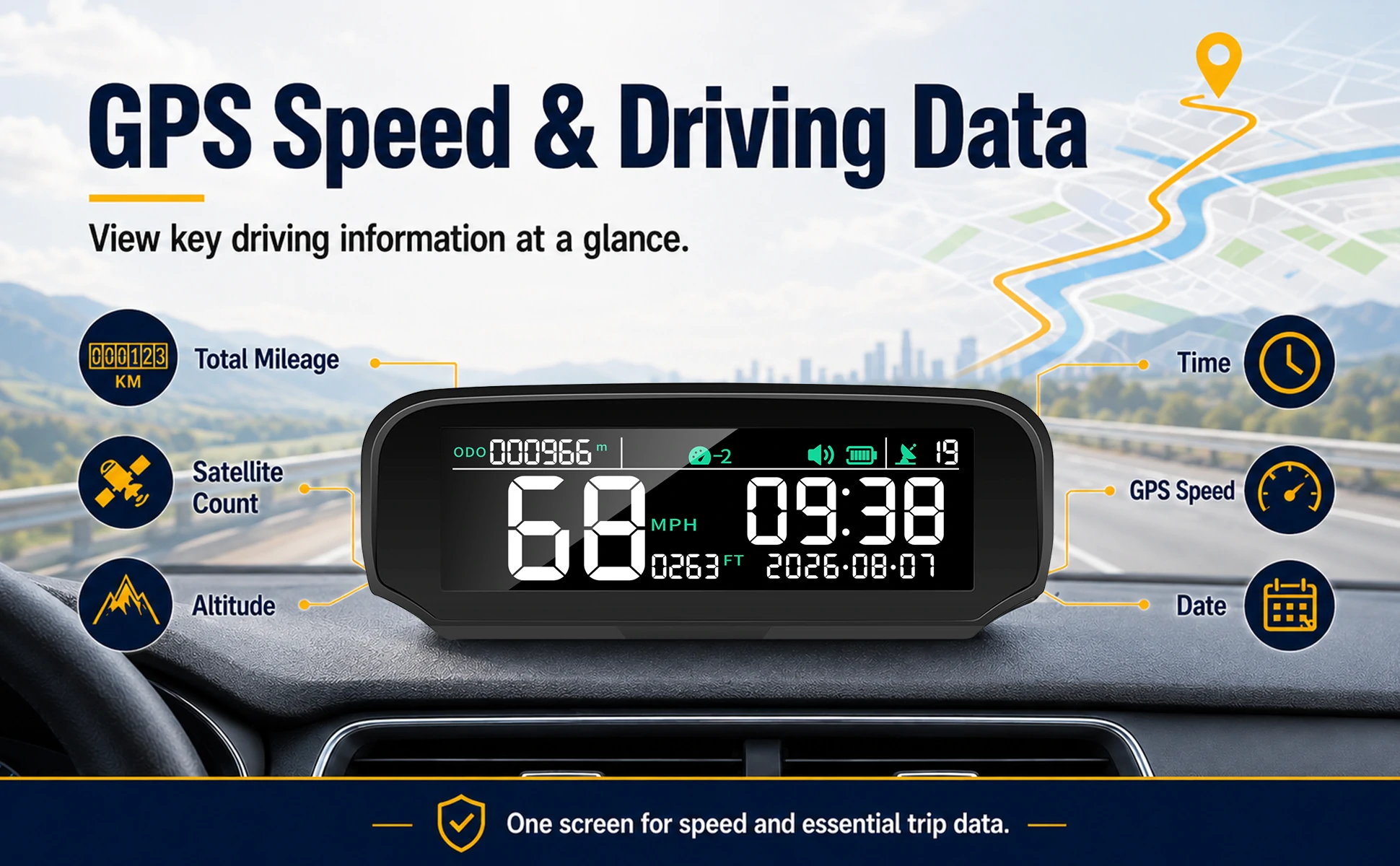
Every position fix includes height above the reference ellipsoid, so the same receiver that gives you speed can give you elevation. The X100 shows altitude as one of its ten on-screen items; the X98 does too, and its manual quotes an altitude error figure of 1 to 80 m.
Time and date, corrected by satellite
GPS time is atomic-clock time. A GPS speedometer without OBD therefore sets its own clock and calendar without a menu dive — a small thing until you are in a rental car in a different time zone with a dash clock you cannot reach.
Satellite count
The X100 displays the number of satellites it is tracking. When that figure drops, you know why the speed number is hesitating, which is far more useful than a blank screen.
Speed compensation
Both units let you offset the reading by a few km/h if you want to match a reference. It is a calibration convenience, not a fix for a broken speedometer.
Mileage — on the X100 only
A GPS receiver can also integrate distance over time, and the X100 does exactly that: total driving distance sits on the main screen, and it can be set by hand to match the mileage your vehicle already carries. Hold button 3 for three seconds, adjust digits with buttons 1 and 3, step across with button 2, hold button 2 to save. It is a single running total rather than a trip meter, which is what an older vehicle or a second-hand work truck usually needs.
X100 or X98: two sizes of GPS speedometer without OBD
Both units answer the same question and neither needs the diagnostic port. They differ in what they carry and how much dashboard they occupy.
| Spec | X100 | X98 |
|---|---|---|
| Screen items | 10 (speed, total mileage, two overspeed alarms, sound, battery, satellites, altitude, date, time) | 8 (speed, alert, fatigue reminder, time, battery, solar indicator, unit, altitude and temperature) |
| Total mileage | Yes, hand-set and adjustable | No |
| Overspeed alarms | Two, switchable with one button | One, 10 to 180 km/h |
| Size / weight | 121 × 110 × 45 × 20 mm, 175 g | 10 × 9.5 × 3 cm, 96 g |
| Battery | 1000 mAh, about 12 h; 13 to 16 h with sun | 1000 mAh, about 20 h; 22 to 24 h with sun |
| Solar input | 29 to 34 mA | 25 mA |
| Temperature range | −20 to +70 °C | −20 to +70 °C |
| OBD required | No | No |
If the vehicle has no working odometer and you want a mileage figure on the dash, the X100 GPS speedometer is the answer: a 175 g unit with the larger body, two alarm thresholds and a ten-item screen. If the dash is crowded or the windshield is shallow, the X98 GPS speedometer does the same core job at 96 g and 10 × 9.5 × 3 cm, with an extra temperature readout instead of mileage.
Neither one is a tire-pressure gauge or an angle gauge. If you want pressure on the same dash, the X91 TPMS display adds four external sensors. If you want pitch and roll for a campsite, the M60 pairs GPS speed with vehicle angle, and our pitch and roll gauge guide explains what those numbers mean. Campers working through the parking routine can start with how to level an RV.
Real limits of a GPS speedometer without OBD
Honesty is more useful than a spec sheet here, so these are the four things a GPS speedometer without OBD will not do.
- It needs sky. Tunnels, parking garages, covered storage and some metallic windshields interrupt reception. The reading resumes when the signal returns.
- It cannot report vehicle faults. No codes, no coolant temperature, no battery voltage — it is not connected to the car at all.
- It carries no tire pressure or angle data. Those need their own sensors, which is why the X91 and M60 exist.
- It does not replace an inspection-grade odometer. The X100’s mileage figure is a dash reference you set yourself, not a certified record.
One more caution belongs in a speeding discussion: a speed display is not a licence to run the limit. Speeding raises stopping distance and rollover risk, particularly in tall vehicles, and the NHTSA speeding overview is worth reading before you decide what your alarm thresholds should be on a GPS speedometer without OBD.
Five steps to set up a GPS speedometer without OBD
- Pick a spot. Center console, unobstructed, out of the airbag path, with daylight reaching the top panel.
- Set the pad. Both units ship with a non-slip pad; the X98 also includes double-sided tape if you prefer a fixed position.
- Power it. Charge by USB first, then let solar assist. The X100 auto-powers with ignition and sleeps after parking, though a unit you switched off by hand stays off.
- Wait for the fix. About 60 seconds cold, about 5 seconds warm on the X100. Leave the unit still while it acquires.
- Set units and alerts. On the X100, hold button 2 for three seconds to enter settings, then step through minute, clock and speed compensation, the fatigue reminder, alarm 1, alarm 2, the KM/H to mph switch and the brightness switch; hold button 2 again to save.

Questions about a GPS speedometer without OBD
Does a GPS speedometer without OBD work on any car?
Yes, as long as the unit can see the sky and the dash has space. Both AUTOSIRS units list wide vehicle compatibility, because speed comes from satellites rather than from the vehicle’s data bus.
Is a GPS speedometer without OBD accurate enough to trust?
It tracks ground speed directly, so it does not inherit errors from tire size or gearing. Expect small variations in dense cover; in open driving the number is steady and repeatable.
Will it drain the car battery?
No. A GPS speedometer without OBD has no connection to the vehicle’s electrical system. It runs on its own 1000 mAh cell, with solar assistance and USB charging.
Can I move it between vehicles?
That is the point of the design. Unclip it, put it in the other car, and the same unit reads the same way. Nothing to unplug, nothing to re-register.
Which one has mileage?
The X100. Its total driving distance can be set to match the vehicle, which makes it the better pick for a dash with a dead odometer. The X98 is the smaller unit and does not carry a mileage figure.
Do these units show altitude and time?
Both do. Altitude comes from the same position fix as speed, and the clock corrects itself once satellites are acquired.
A GPS speedometer without OBD measures ground speed from satellites, needs no diagnostic port and no wiring, tops itself up with solar, and can carry altitude, time, satellite count and — on the X100 — a settable total mileage. Pick X100 for mileage and a larger screen, X98 for a 96 g footprint.
Ready to skip the OBD port? Compare the X100 GPS speedometer with mileage against the compact X98, and check the rest of the AUTOSIRS driving displays if you also want tire pressure or vehicle angle on the same dash.