
What Is a Pitch and Roll Gauge? Off-Road Angles Explained
You feel it before you see it. You crest a ridge at 20 mph, the left rear tire drops into a rut, and the whole truck leans — eighteen degrees, maybe twenty-two — while your brain is still deciding whether that is fine or whether you are about to put it on its side. By the time you have an opinion, the moment is gone.
A pitch and roll gauge exists to answer that question with a number instead of a feeling. This guide covers what the two angles actually measure, why trail rigs need a wider range than street cars, and how the five AUTOSIRS displays differ when you are shopping for one.
What a pitch and roll gauge actually measures
Two angles, measured against level ground:
- Pitch is rotation front-to-back. Nose up on a climb, nose down on a descent, or the tongue of a trailer sitting high. Pitch tells you how steep the line is.
- Roll is rotation side-to-side. The lean you get on an off-camber shelf road, a sidehill, or a rut that swallows one wheel. Roll is the one that ends trips.
A pitch and roll gauge that reads both axes is a dual-axis inclinometer. It does not care about speed, engine load or tire pressure: it reads the attitude of whatever it is bolted to, which is why the same instrument works on a Jeep, a tow rig, a travel trailer or a motorhome.
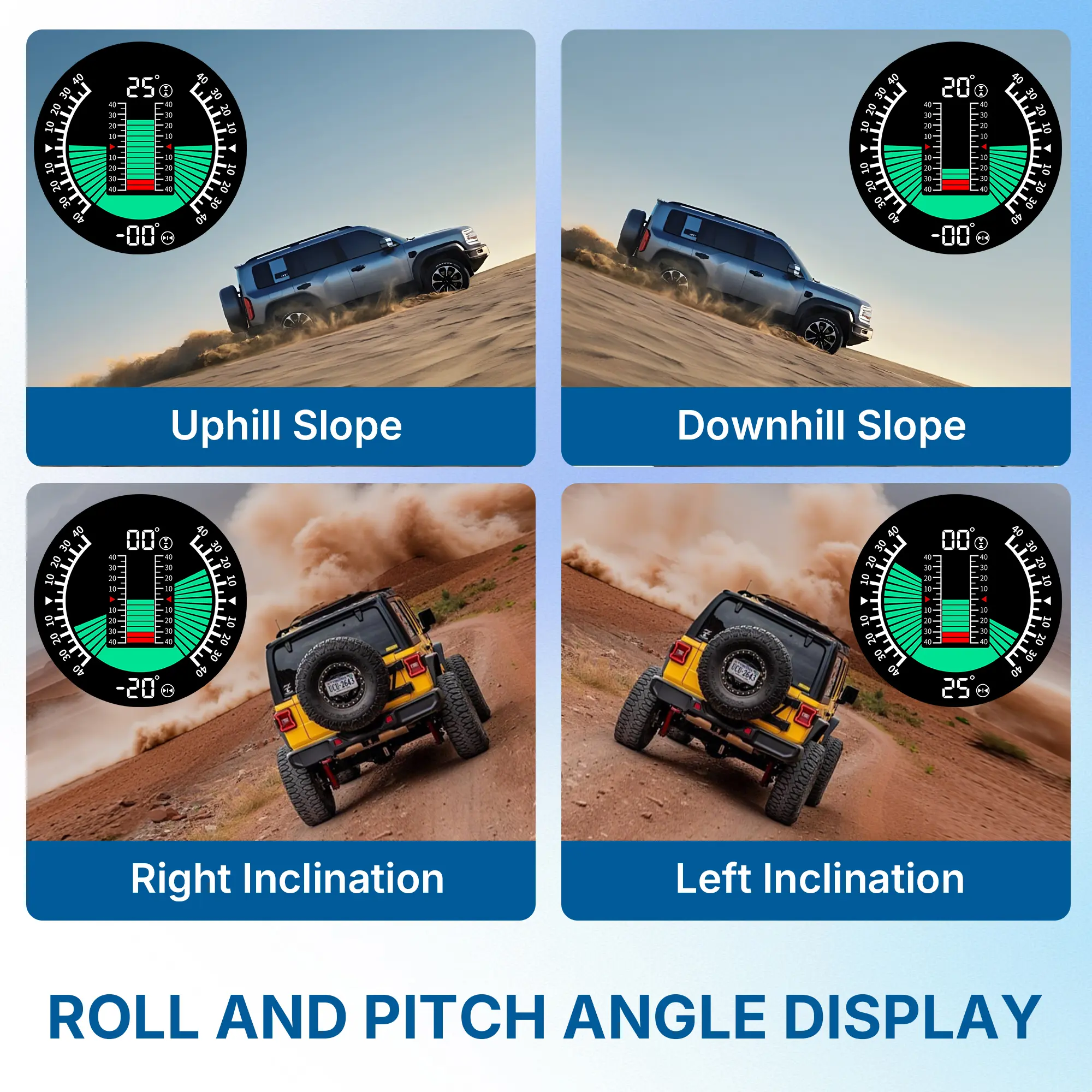
The number that matters when shopping for a pitch and roll gauge is the range. A street car rarely sees more than three or four degrees. A trail rig routinely sees fifteen, and a bad line can put you past thirty. That is why these displays are built to ±40° — enough headroom to show a real number on the worst line you would ever deliberately take, rather than pegging the display at “too much.”
Why the number matters more than the feeling
The human body is a poor inclinometer. Seated in a cab with suspension travel, tire squish and a tilted horizon, most drivers underestimate roll by several degrees — which is exactly why a pitch and roll gauge beats a gut call.
Rollovers are also not mostly a speed problem. The NHTSA’s guidance on rollover causes points at geometry and load: a high center of gravity, a narrow track, and a side load that pushes the center of mass past the outside tires. On a trail, that side load is gravity on an off-camber slope, plus whatever is strapped to the roof.
Practical trail arithmetic, in degrees of roll:
- Under 10° — normal shelf road. Drive it.
- 10–15° — worth noticing. Check your line, check what is on the roof.
- 15–20° — pick a different line if one exists. A spotter earns their keep here.
- 20–30° — this is where a lifted rig with a roof tent starts feeling honest about its center of gravity.
- Above 30° — you are past what most trail vehicles are built to hold statically. Stop and think.
Pitch has its own uses: climb and descent angles, approach and departure limits, whether the trailer tongue is high enough, and whether the truck is actually sitting level when you park for the night.
Degrees are not percent grade
Trail signs, forestry roads and some vehicle specs quote grade in percent, and the two scales diverge fast. Percent grade is the tangent of the angle, so a slope that reads 20° is a 36% grade — not 20%.
| Degrees | Percent grade | What it feels like |
|---|---|---|
| 5° | 8.7% | A steep driveway |
| 10° | 17.6% | A serious forest road climb |
| 15° | 26.8% | Steep enough to want low range |
| 20° | 36.4% | Airing-down territory |
| 25° | 46.6% | Trail buggy climb |
| 30° | 57.7% | Past most street-legal capability |
| 40° | 83.9% | Rock crawler on sticky tires |
If a pitch and roll gauge only shows one scale, make sure you know which one you are reading. Every AUTOSIRS display below reports degrees.
How these gauges work, and what they will not do
Inside every pitch and roll gauge here is a solid-state accelerometer — in the wireless model below, a six-axis gyro — that measures gravity’s direction relative to the sensor. Calibration is the whole trick: park on known level ground, hold the calibration buttons until it beeps, and the unit treats that attitude as zero. Recalibrate if you move the unit, change the mount, or suspect it drifted.
Three limits worth knowing before you buy any pitch and roll gauge:
- It reads where it is mounted, not where you are sitting. A gauge on a tilted dash bracket reads a tilted dash. Mount it level.
- It is a static attitude reading. It tells you the angle right now; it does not predict how much further the body will lean when a wheel lifts.
- It is not a leveling system. It shows you the angle; you still move the blocks, run the jacks or pick the campsite.
Five pitch and roll gauges compared
All five pitch and roll gauges below share the same ±40° angle engine. The differences are what else shares the screen, and whether the screen is attached to the vehicle at all.
| Model | Beyond the angles | Angle range | Power | Best for |
|---|---|---|---|---|
| M50 | Battery voltage only. No GPS. | ±40° roll, ±40° pitch | DC 11.5–30 V, 5-DC12V adapter | Budget angle gauge, dedicated trail toy |
| M60 | GPS speed, odometer, altitude, latitude/longitude, compass, voltage | ±40° dual axis | DC 11.5–30 V, 1.5 m cable | Daily driver that also runs trails |
| X90 | GPS speed, altitude, lat/long, compass, voltage, clock | ±40° dual axis | DC 11.5–30 V, 1.5 m cable | Big-screen all-in-one dash display |
| X91 | Everything in the X90 plus four external TPMS sensors: pressure and temperature per tire | ±40° dual axis | DC 11.5–30 V | Tow rigs and long highway days |
| AM350PRO | Wireless transmitter plus separate display; RV leveling mode at 0.1° resolution | ±40° off-road, ±4° RV | Rechargeable, Type-C | Multi-vehicle use, reading angles from outside |
M50 — the purest pitch and roll gauge
The M50 is the least complicated pitch and roll gauge of the five: roll, pitch and battery voltage on a 127 mm screen, with a city interface and an off-road interface, brightness you can dim by hand and a screen you can rotate. No GPS, no speed, no compass. It weighs 230 g, runs on 11.5–30 V through a 5-DC12V adapter and mounts by adhesive pad or suction-and-screw. If you already have a speedometer and just want to know the angle, this is the cheapest way to get it.
M60 — angles plus GPS speed in a compact body
The M60 is the same dual-axis logic with a speedometer built in: GPS speed, an odometer, altitude, latitude and longitude, a compass and voltage, in a 127 × 60 × 25 mm housing that weighs 137 g and takes a suction mount or double-sided tape. Speed comes from GPS, so there is no OBD-II dongle and no tire sensors. It also carries an overspeed alarm and a fatigue reminder. For a rig that gets driven to work and wheeled on weekends, this is the practical middle.
X90 — the full dash in a bigger housing
The X90 moves the same data onto a 170 × 70 × 60 mm display at 203 g, keeps GPS speed and angles plus altitude, compass and voltage, and adds a clock. Speed accuracy is quoted under 0.36 km/h on GPS plus BeiDou, with a cold start of about 32 seconds and a hot start around 10. It is the version to choose when the display is meant to be the dashboard rather than a small pitch and roll gauge on the A-pillar.
X91 — the tow-rig version
The X91 keeps everything the X90 shows and adds a set of four external valve-cap tire sensors, so pressure and temperature for all four tires share the screen with speed and the pitch and roll gauge angles. That combination matters on a highway day: a tire going soft at 70 mph is a different problem from a slope. The display is 170 × 70 × 60 mm and 203 g, reads in MPH or KMH and PSI or BAR, and still needs no OBD-II connection for speed.
AM350PRO — the one you can read from outside the vehicle
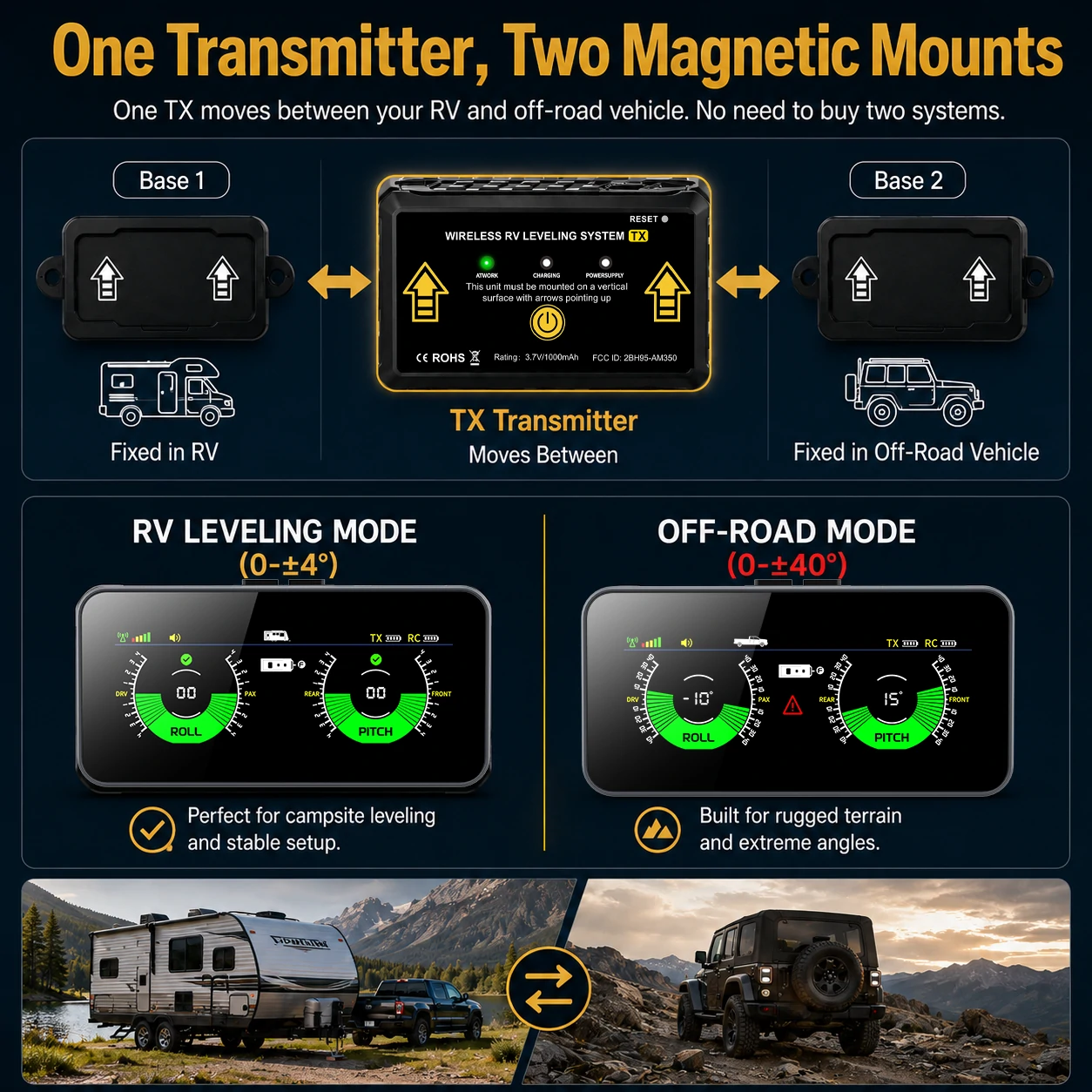
The AM350PRO is the only pitch and roll gauge here that splits the system in two: a wireless transmitter mounted on the frame or wall, and a display you keep in your hand or on the dash. The link is rated to 150 feet and works through metal RV walls, so you can watch the angle while you are outside moving leveling blocks. Off-road mode runs ±40° with 1° spacing, warns past 20° and switches to an emergency alarm past 30°; RV leveling mode tightens to ±4° at 0.1° resolution with a green check once you are inside half a degree. The transmitter runs about 100 hours per charge, the display about 8, both over Type-C. No phone app involved.
Five ways to buy a pitch and roll gauge
- Just the angle, lowest cost: M50.
- Angle plus speed, small footprint: M60.
- The display is the dashboard: X90.
- Towing, tires matter as much as slope: X91.
- More than one vehicle, or you want to read it while standing outside: AM350PRO.
The short version
Pitch is the climb; roll is the lean that puts trucks on their roofs. A pitch and roll gauge that reads both to ±40° costs less than a single body panel, and it turns a gut call into a number you can act on before the line gets expensive.
Angles quoted here come from the supplied AUTOSIRS manuals. A dash gauge supplements judgment; it does not replace a spotter, tire checks or knowing your vehicle’s limits.
Shop the pitch and roll gauge range
M50 slope meter · M60 GPS slope and speed meter · X90 GPS speedometer and inclinometer · X91 TPMS, GPS speed and inclinometer · AM350PRO wireless RV leveling system